September 14, 2026
How Can AI Startups Scale Inference Without Buying or Managing GPUs?

Training a model may receive most of the attention, but inference is where an AI product meets real users. Every generated image, chatbot response, transcription, recommendation, or video requires infrastructure capable of running a model reliably. As usage grows, inference can become one of the largest and least predictable operating costs for an AI startup.
The traditional answer has been to purchase GPUs or reserve them through a centralized cloud provider. Both approaches can work, but they introduce commitments that many early-stage companies would rather avoid. Buying hardware requires significant capital, while reserved cloud capacity can leave a startup paying for GPUs that are not always being used.
AI startups need another option: infrastructure that provides access to suitable GPUs when demand appears, without forcing the company to own hardware or manage a GPU cluster. Distributed GPU networks such as Nosana offer one way to access that flexibility.
What Is AI Inference?
AI inference is the process of running a trained machine-learning model to produce an output from new input. When someone submits a prompt to a language model, uploads an image for analysis, generates a video, or asks an application to transcribe audio, the model performs inference.
Training creates or adjusts the model. Inference uses that model inside a product.
Although a model may only be trained occasionally, inference can happen continuously. Every new user and every additional request creates more demand for compute. Inference infrastructure must therefore support changing workloads, maintain acceptable response times, and remain economically sustainable as usage increases.
Why Is Scaling AI Inference Difficult for Startups?
GPU demand rarely grows in a predictable, linear way. A startup might have little activity during development, followed by a sudden spike after a launch, integration, customer campaign, or viral post. The team must be ready for that increase without paying for maximum capacity throughout quieter periods.
Different models also have different hardware requirements. A lightweight text model may run comfortably on a smaller GPU, while a video-generation model or larger language model may require significantly more VRAM. Using the most powerful GPU for every workload is unnecessarily expensive, but selecting the cheapest available option without considering memory and performance can result in failed deployments or poor user experiences.
The infrastructure itself adds another layer of work. A team operating its own GPUs must manage drivers, runtime environments, containers, model files, monitoring, networking, security, and hardware maintenance. These responsibilities can consume engineering time that would otherwise be spent improving the product.
Do AI Startups Need to Buy GPUs to Run Inference?
An AI startup does not need to own GPUs to run or scale inference. Renting GPUs is common across the AI industry, but it is particularly valuable for early-stage teams that need flexibility without a large upfront investment.
Purchasing hardware may make sense when workloads are stable and predictable. For a startup, however, demand can change quickly, while buying GPUs creates immediate responsibilities for utilization, maintenance, cooling, power, upgrades, and eventual replacement.
AI workloads can also evolve faster than the hardware supporting them. A startup may purchase GPUs for its current model and later require more VRAM, a different GPU class, or another deployment configuration. Renting compute avoids locking the team into infrastructure that may no longer fit its needs.
On-demand infrastructure allows startups to test different models, select suitable hardware for each workload, and adjust capacity as demand changes—without building and maintaining a physical GPU cluster.
What Are the Alternatives to Managing a GPU Cluster?
AI startups generally have three alternatives to operating their own GPU infrastructure: managed inference APIs, centralized GPU clouds, and distributed GPU networks.
Managed inference APIs offer the simplest experience because the provider hosts the model and charges for requests or generated output. This works well for rapid prototyping, but it gives the startup less control over model selection, deployment configuration, pricing, and the underlying infrastructure. Costs can also become difficult to optimize as request volume grows.
Centralized GPU clouds provide more flexibility by allowing teams to rent machines or containers. However, users may still encounter capacity restrictions, complex pricing, long-term commitments, or substantial infrastructure-management requirements.
Distributed GPU networks aggregate hardware supplied by independent providers and make it accessible through a common platform. This gives developers another way to access GPU capacity without owning physical infrastructure or depending entirely on a conventional cloud provider.
How Do Distributed GPU Networks Support AI Inference?
A distributed GPU network connects AI workloads with available GPUs from independent compute providers. Instead of relying on a single data center or purchasing dedicated hardware, developers submit a workload that can be matched with compatible infrastructure.
Nosana applies this model to AI compute. Developers can select a GPU market based on hardware requirements, price, and availability, then deploy a containerized workload to the network. The host supplies the GPU resources, while Nosana coordinates workload execution and payment.
For an AI startup, the practical benefit is not decentralization alone. It is access to GPU compute without having to source, install, and operate the physical hardware. Teams retain control over their workloads and deployment configurations while avoiding many of the responsibilities associated with managing a GPU cluster.
How Can AI Startups Scale Inference on Nosana?
The first step is to package the inference service as a containerized workload. The container includes the application, model-serving framework, required dependencies, and everything needed to run the service consistently across different hosts.
The team must then estimate the workload’s actual hardware requirements. Model size matters, but so do context length, batch size, precision, concurrent requests, and memory used during inference. A realistic test deployment is usually more useful than selecting hardware based only on a model’s published parameter count.
Before selecting a GPU, teams should understand how much VRAM their workload requires. Our practical VRAM guide explains how model size, precision, context length, batch size, and inference type affect GPU requirements.
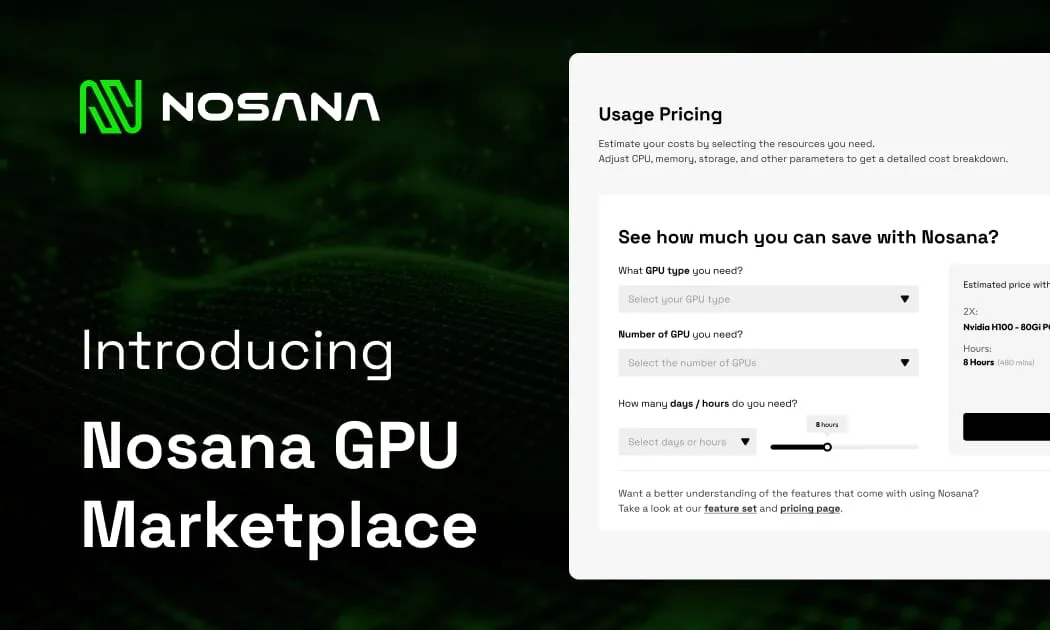
Once those requirements are clear, the startup can select a suitable GPU market on Nosana. There is no need to use the largest available GPU for every workload. Matching each model with the most affordable GPU that can run it reliably is one of the most effective ways to control inference costs. Teams can compare available GPUs and calculate their estimated workload costs with the Nosana GPU calculator.
The workload can then be deployed on a compatible host and connected to the startup’s application through an endpoint. As demand changes, the application can launch additional deployments, distribute traffic between instances, or stop capacity it no longer needs.
This allows startups to scale inference without purchasing hardware or maintaining their own GPU infrastructure. The application determines when additional capacity is needed, while Nosana provides access to the compute used to run it.
Can Nosana Handle Production AI Inference at Scale?
Production inference does not require owning a GPU fleet. With Nosana, startups can run multiple inference deployments and use their application infrastructure to distribute requests and adjust capacity as product usage grows.
This allows a team to start with the compute it needs today, validate demand, and expand without purchasing hardware in advance. Multiple deployments can be combined with monitoring, traffic routing, and failover to create a more resilient production environment.
Instead of spending time maintaining physical GPU infrastructure, startups can focus on improving their models, applications, and user experience while accessing GPU capacity through Nosana as their requirements evolve.
How Can Startups Reduce AI Inference Costs?
Reducing inference costs starts with selecting a GPU that fits the workload—not simply choosing the newest or most powerful option. If a model runs reliably on a more affordable GPU while meeting the required speed and quality, paying for additional performance provides little practical value.
Teams can reduce costs further by optimizing how the model runs. Techniques such as quantization, lower-precision inference, caching, and batching can decrease the compute required for each request without necessarily affecting the user experience.
Utilization is equally important. An inexpensive GPU becomes costly when it sits idle for long periods. Startups should compare options based on realistic usage patterns and allocate capacity according to actual demand. The Nosana GPU calculator can help teams compare available GPUs and estimate workload costs before deploying.
What Should an AI Startup Look for in an Inference Platform?
The right inference platform should fit both the workload and the company’s current stage. Startups should compare GPU availability, performance, deployment costs, operational effort, and the flexibility to change infrastructure as their products evolve.
The lowest hourly GPU price does not always produce the lowest overall cost. Slow deployment, limited availability, unnecessary capacity, and time spent managing infrastructure can quickly erase the apparent savings. Managed APIs may be convenient initially, but per-token, per-image, or per-video pricing can become expensive as usage grows.
For an early-stage team, the strongest option is often one that enables experimentation without a major upfront commitment while providing a clear path to greater capacity as demand increases.
Scale AI Inference Without Owning the Infrastructure
Nosana gives AI startups access to distributed GPU compute without requiring them to purchase hardware, build a GPU cluster, or commit to a rigid infrastructure setup.
Teams can package their models as portable workloads, select GPUs based on their actual requirements, and adjust capacity as their products grow. This provides more freedom to experiment, control costs, and adapt when models or demand change.
Instead of investing in infrastructure before knowing exactly what the product will need, startups can direct more of their resources toward building a better application. Explore available GPUs and calculate your workload costs on Nosana.
Frequently Asked Questions
Can an AI startup run inference without owning GPUs?
AI startups can run inference through managed APIs, centralized cloud GPU providers, or distributed GPU networks such as Nosana. The right option depends on the level of control, flexibility, and infrastructure management the team requires.
What is the difference between AI training and inference?
Training is the process of creating or adjusting a model using data. Inference occurs when the trained model receives new input and generates an output. Training is usually periodic, while inference may run continuously as users interact with an AI product.
What type of GPU is needed for AI inference?
The right GPU depends primarily on the model, available VRAM, precision, context length, batch size, and expected request volume. Smaller language models and lightweight image-processing workloads may run on GPUs with 8–12 GB of VRAM, while larger language models, high-resolution image generation, and video models may require 24–48 GB or more.
For example, a quantized 7B language model may fit within 8–12 GB of VRAM, while a 13B model commonly needs around 16–24 GB, depending on precision and context length. Larger models or demanding video-generation workloads may require 48 GB or more. Teams should benchmark the complete workload because runtime memory usage can exceed the space required to load the model alone.
For a more detailed breakdown, see our practical guide to choosing a GPU based on VRAM requirements.
Is decentralized GPU compute cheaper than a traditional cloud?
Decentralized GPU compute gives startups greater control over their workloads, infrastructure choices, and data. Instead of relying entirely on a centralized provider that controls the platform and its terms, teams can deploy their own containerized applications while retaining ownership of their models and data.
It can also provide access to competitively priced GPU capacity through an open network. However, teams should still apply appropriate encryption, credential management, and data-protection practices when handling sensitive information.
Can Nosana run containerized AI models?
Nosana supports containerized GPU workloads, allowing developers to define the runtime environment and deploy model-serving applications on compatible GPU hosts available through the network.
How should an AI startup begin scaling inference?
The startup should first benchmark its model, identify the minimum GPU and VRAM requirements, and containerize the serving environment. It can then test the workload under realistic conditions, measure performance and cost, and expand the deployment as demand grows.
Ready to run an inference workload without buying or managing GPUs? Deploy it on Nosana.
Useful Links
Stay Updated with Nosana
Get the latest insights on AI infrastructure, GPU launches, and network innovations — all in one place