June 19, 2026

How to Build AI Workflows That Produce Better Outputs, Not AI Slop
How to Build AI Workflows That Produce Better Outputs, Not AI Slop

Everyone is building AI workflows now, and honestly, that is a good thing. AI can help teams move faster, automate repetitive work, summarize messy information, generate first drafts, analyze data, support users, and turn scattered inputs into something usable. The problem is not that people are using AI too much. The problem is that too many workflows are built with the same lazy logic: give the model a vague task, ask it to produce something impressive, and hope the output is useful enough to ship. That is how we get AI slop. Not because the model is always bad, and not because automation is somehow less creative, but because the system around the model has no taste, no context, no checks, and no real definition of what “good” means.

AI slop usually looks polished at first glance. It has clean formatting, confident language, maybe even a few decent ideas, but the more you read it, the more you realize it could have been written for anyone, by anyone, about anything. It sounds like a blog post that says a lot and commits to nothing. It sounds like a sales email that knows your first name but has no idea what you actually need. It sounds like a report that summarizes the obvious while missing the decision that matters. The issue is not that AI made it. The issue is that the workflow was designed to generate output instead of value.

A good AI workflow should not begin with the question, “How do we make this faster?”

It should begin with, “What would make this genuinely useful?” That small shift changes everything. If you are building a workflow for content, the goal is not just to publish more posts. The goal is to produce sharper ideas, better angles, clearer explanations, and material that actually helps the reader understand something. If you are building a workflow for support, the goal is not just to answer faster. The goal is to solve the user’s problem with the right level of accuracy and context. If you are building a workflow for agents, the goal is not just to connect tools and models together. The goal is to create a system that can make progress on a task without producing a trail of confident nonsense along the way.

The first step is to define the job before you define the prompt. A prompt is just an instruction, but a job is the actual outcome you want. “Write a blog about AI workflows” is a prompt. “Help builders understand why their AI outputs feel generic and how to design workflows that produce more reliable results” is a job. “Summarize this document” is a prompt. “Extract the decisions, risks, owners, and next steps so the team can act without rereading everything” is a job. When the job is clear, the AI has something real to optimize for, and the workflow becomes much easier to structure because every step can be judged against a purpose.

The second step is to stop feeding the model vibes and start feeding it context. A lot of bad AI output comes from asking the model to invent depth from almost nothing. If you want a workflow to produce useful work, it needs access to the material that would make a human better at the task too. That might be product documentation, customer research, analytics, previous high performing content, technical notes, brand examples, user feedback, market data, code repositories, support tickets, or internal strategy. The point is not to dump a giant folder into the model and hope it magically understands what matters. The point is to design the workflow so that the right context appears at the right moment, and the AI is not forced to bluff its way through missing information.

The third step is to break the workflow into stages instead of relying on one giant magic prompt. One of the fastest ways to produce AI slop is to ask the model to do research, reasoning, drafting, editing, fact checking, formatting, and strategy in one move. It might still produce something that looks complete, but you have no control over how it got there. A better workflow separates the process. First, collect the inputs. Then identify the audience and the goal. Then extract the strongest facts or insights. Then decide the angle. Then draft. Then review the draft against the original purpose. Then improve the language. Then prepare it for the final channel. This does not make the workflow less automated. It makes the automation less chaotic.

The fourth step is to add quality checks where they actually matter. Not every workflow needs a human reviewing every sentence, because that would defeat the point of automation. But every serious workflow needs some kind of gate that prevents weak output from moving forward simply because it exists. A content workflow can check whether the draft contains specific claims, real examples, and a clear point of view. A sales workflow can check whether the personalization is based on actual information or just fake friendliness. A support workflow can check whether the answer is grounded in source material. A coding workflow can run tests instead of trusting that the code looks fine. A research workflow can separate evidence from interpretation. These checks are the difference between AI that helps and AI that creates cleanup work for someone else later.

The fifth step is to build feedback loops instead of content factories. A workflow that only produces more output is not really intelligent. It is just productive. The better question is what happens after the output is used. Did the article get read? Did the email get replies? Did the support answer solve the ticket? Did the generated code pass tests? Did the user accept the answer or rewrite most of it? Did the agent complete the task or loop around the same problem five times? These signals are what help workflows improve. Without feedback, teams end up scaling mediocrity and calling it efficiency.

This is also where infrastructure starts to matter more than people usually admit.

When AI workflows are small experiments, it is easy to think only about prompts and tools. But as soon as workflows become real products, the compute layer becomes part of the product experience. More steps mean more model calls. Better evaluation means more runs. Larger context means heavier workloads. Multimodal inputs mean more processing. Agents that operate continuously need reliable execution. If the infrastructure is expensive, limited, or difficult to scale, teams naturally start cutting corners, and those shortcuts often show up as worse outputs.

That is why Nosana is relevant to this conversation. Nosana gives builders access to decentralized GPU compute for AI workloads, which makes it easier to experiment, run, and scale AI systems without depending only on traditional centralized cloud infrastructure. For builders creating agents, automation products, inference workflows, or AI powered applications, this matters because quality is not only a prompt problem. It is also an execution problem. A good workflow needs enough compute behind it to run the steps that make the output better: retrieval, generation, evaluation, reruns, testing, and iteration. When compute becomes more accessible, builders can design workflows for quality instead of designing around scarcity.

The future of AI workflows will not be won by whoever generates the most content.

We already have enough content. It will be won by teams that build systems people can actually trust. Systems that know the task. Systems that use the right context. Systems that check their own work. Systems that improve from feedback. Systems that can run reliably when usage grows. That is the difference between an AI workflow that produces noise and an AI workflow that becomes part of how real work gets done.

AI slop is not inevitable. It is what happens when teams automate without designing. The fix is not to use less AI, and it is definitely not to go back to doing everything manually. The fix is to build better workflows around the AI: clearer jobs, better context, smaller steps, smarter checks, stronger feedback loops, and infrastructure that can support real execution. That is where AI starts to feel less like a content machine and more like a useful system.

At Nosana, this is the kind of future we are building toward. Not louder AI, not more empty output, not another layer of generic automation, but the compute foundation for builders who want to create AI workflows that are actually worth running.

Stay Updated with Nosana

Get the latest insights on AI infrastructure, GPU launches, and network innovations — all in one place

Catch Up on Nosana's Recent Blogs

Run your AI jobs across a decentralized GPU grid. No lock-ins, no downtime, no inflated cloud bills just pure compute power, when you need it.

Why AI Apps Feel Slow: The AI Infrastructure Problem Behind Every Product
June 12, 2026 |

Why AI Apps Feel Slow: The AI Infrastructure Problem Behind Every Product

The Real Cost of AI Agents
June 5, 2026 |

The Real Cost of AI Agents

Why Inference Is the Hidden Bill Behind Every AI App

May on Nosana: Builders, GPU Demand, Community Momentum, and What’s Next
May 29, 2026 |

May on Nosana: Builders, GPU Demand, Community Momentum, and What’s Next

May was a strong month for the Nosana ecosystem.

What to Build for the HackerNoon x Nosana Decentralized AI Hackathon
May 27, 2026 |

What to Build for the HackerNoon x Nosana Decentralized AI Hackathon

AI is no longer just about prompts.

GPU Rental for AI Agents: What Infrastructure Do Autonomous Workloads Actually Need?
May 13, 2026 |

GPU Rental for AI Agents: What Infrastructure Do Autonomous Workloads Actually Need?

AI agents need flexible, on-demand GPU compute. Here's what autonomous workloads actually require from GPU rental and how Nosana fits into the modern AI infrastructure stack.

Cloud GPU Providers Compared: Which GPU Cloud Should You Choose for AI Workloads?
May 6, 2026 |

Cloud GPU Providers Compared: Which GPU Cloud Should You Choose for AI Workloads?

Compare traditional cloud GPU providers with distributed GPU networks for AI inference, AI training, GPU rental pricing, and flexible GPU compute.

Nosana Monthly — April Edition
April 30, 2026 |

Nosana Monthly — April Edition

Builders, New Models, Product Updates, Partnerships & Community Growth

Fourth Builders’ Challenge Recap: What Builders Created on Nosana
April 28, 2026 |

Fourth Builders’ Challenge Recap: What Builders Created on Nosana

The fourth Nosana Builders’ Challenge showed what happens when developers are given open infrastructure, real incentives, and the freedom to experiment.

Nosana × Zero Query: Powering Autonomous Trading Agents
April 7, 2026 |

Nosana × Zero Query: Powering Autonomous Trading Agents

A new primitive: trading without human execution.

Nosana Monthly — March Edition
April 1, 2026 |

Nosana Monthly — March Edition

From launching the new Nosana experience and Deploy page, to privacy-first AI with Arcium, expanding AI access for African languages, and Builders Challenge #4 with ElizaOS — March brought major product upgrades and growing ecosystem momentum.

Nosana x ElizaOS Agent Challenge
March 25, 2026 |

Nosana x ElizaOS Agent Challenge

Build personal AI agents with ElizaOS and deploy them on Nosana's decentralized GPU network. Compete for $3,000 USDC in prizes!

The New Nosana Experience Is Live
March 13, 2026 |

The New Nosana Experience Is Live

Today marks a major step forward for Nosana.

Empowering African Languages with AI: How Christex and Geneline-X Use Nosana to Build Inclusive Voice Models
March 5, 2026 |

Empowering African Languages with AI: How Christex and Geneline-X Use Nosana to Build Inclusive Voice Models

Artificial intelligence is reshaping education, communication, and economic opportunity, but only for the languages and communities it supports.

Nosana Grants Program Welcomes AiMo Network
March 3, 2026 |

Nosana Grants Program Welcomes AiMo Network

Nosana is pleased to welcome AiMo Network as an official Nosana Grantee through the Nosana Grants Program.

Nosana Monthly - February Edition
March 2, 2026 |

Nosana Monthly - February Edition

From launching the Nosana Learning Hub, to expanding real GPU supply through OpenGPU, rolling out infinite restart strategies by default, and partnering with Sallar and Alio, the Nosana GPU Marketplace is scaling across infrastructure, tooling, and ecosystem integrations.
Nosana 🤝 OpenGPU: Expanding Access to AI Compute
February 5, 2026 |

Nosana 🤝 OpenGPU: Expanding Access to AI Compute

The infrastructure behind artificial intelligence is changing rapidly. As demand for GPU power continues to rise, so does the need for more open, efficient, and accessible computing solutions.

🚀 January on Nosana: Milestones, Momentum & What’s Next
January 30, 2026 |

🚀 January on Nosana: Milestones, Momentum & What’s Next

January was one of those months where you pause for a second, look at the numbers, the people, the product and realize just how much ground has been covered.

December Recap: Closing the Year in Motion
December 30, 2025 |

December Recap: Closing the Year in Motion

December didn’t just close the year, it validated the network! Real GPU workloads, builders shipping in production, and milestones that matter!

Introducing @nosana/kit, the comprehensive 2.0 toolchain for Nosana
December 23, 2025 |

Introducing @nosana/kit, the comprehensive 2.0 toolchain for Nosana

Comprehensive toolchain for managing jobs, markets, runs, and protocol operations on the Nosana compute network.

Nosana 2025: From Testnets to Real-World Compute
December 23, 2025 |

Nosana 2025: From Testnets to Real-World Compute

In 2025, Nosana reached a point of maturity where experimentation gave way to production and decentralized compute shifted from an emerging idea into dependable infrastructure.

The Heart of Nosana: Nosvember 2025 Recap
December 18, 2025 |

The Heart of Nosana: Nosvember 2025 Recap

As the dust settles on another unforgettable Nosvember, it’s clear once again: the Nosana community is the heart of everything we do.

The Nosana Grants Program: Fueling the Next Wave of AI Builders, Vibers, and Dreamers
December 10, 2025 |

The Nosana Grants Program: Fueling the Next Wave of AI Builders, Vibers, and Dreamers

Access $5K-$50K in funding, compute credits, and decentralized GPU infrastructure to build the next generation of AI products.

Agent 102 Recap: MCP, Mastra, and the Next Wave of AI Builders
December 4, 2025 |

Agent 102 Recap: MCP, Mastra, and the Next Wave of AI Builders

Agent 102 our third Builders’ Challenge, pushed the bar higher and our builders cleared it with style.

Nosana Monthly - November Edition
December 1, 2025 |

Nosana Monthly - November Edition

A month of community, builders, and next-gen AI.

Visual Command Center: Managing Deployments with Nosana's Dashboard
November 20, 2025 |

Visual Command Center: Managing Deployments with Nosana's Dashboard

Part 2 of our deployment series: Discover how our new dashboard makes managing distributed deployments as intuitive as clicking a button.

Nosana’s Spare GPU Capacity Is Now Powering Scientific Research
November 12, 2025 |

Nosana’s Spare GPU Capacity Is Now Powering Scientific Research

Nosana’s spare GPU power now fuels Folding@Home, advancing global biomedical research and showcasing the real-world impact of decentralized compute.

Nosana Monthly - October Edition
November 10, 2025 |

Nosana Monthly - October Edition

This month has marked a major step in Nosana’s journey. We’ve expanded into new regions, launched new tooling, partnered with leading ecosystems, and brought hundreds of builders into the decentralized AI future.

From Proposal to Vote: How NNP-0001 Will Be Decided
November 5, 2025 |

From Proposal to Vote: How NNP-0001 Will Be Decided

This post explains timeline, eligibility, and the voting procedure so every holder knows how to participate.

Nosvember Games: A month of celebration for the Nosana Community!
November 3, 2025 |

Nosvember Games: A month of celebration for the Nosana Community!

With November ahead, we’re bringing back Nosvember — a full month dedicated to the Nosana community.

From Yield to Growth: Aligning NOS Rewards with Real Usage!
October 22, 2025 |

From Yield to Growth: Aligning NOS Rewards with Real Usage!

The first Nosana Network Proposal NNP-001 Tokenomics is live. The proposal has a simple goal to make NOS rewards work harder by funding what grows the network.

Elevating the Deployment Experience: Introducing Nosana's New Deployment Manager
October 16, 2025 |

Elevating the Deployment Experience: Introducing Nosana's New Deployment Manager

This is the first article in our technical series exploring how we're revolutionizing deployments on the Nosana network.

Builders Challenge - Agents 102
October 10, 2025 |

Builders Challenge - Agents 102

Build intelligent AI agents with Mastra and deploy them on Nosana's decentralized network. Compete for $3,000 USDC in prizes!

Nosana Expands Across Asia: Powering the Future of AI Infrastructure
October 1, 2025 |

Nosana Expands Across Asia: Powering the Future of AI Infrastructure

Asia: the fastest-growing hub for AI and Web3

How We're Helping AI Startups Cut Costs by 67% With Open-Source Models
August 7, 2025 |

How We're Helping AI Startups Cut Costs by 67% With Open-Source Models

Nosana helps AI startups dramatically reduce operational costs by replacing expensive proprietary AI models with optimized open-source alternatives.

Agent 101 Recap: How Builders Took on the Nosana Challenge
July 18, 2025 |

Agent 101 Recap: How Builders Took on the Nosana Challenge

Agent 101 was our second Builders’ Challenge, a call to action for devs to build smart, scalable AI agents that run on Nosana’s decentralized GPU network. And the community more than delivered.

Builders Challenge - Agents 101
June 25, 2025 |

Builders Challenge - Agents 101

Second edition of the Nosana Builders's Challenge, build and deploy Agents — and compete for over 3,000 USDC in prizes

Builders Challenge - Create a Nosana Template
March 31, 2025 |

Builders Challenge - Create a Nosana Template

This is your chance to showcase your skills, gain visibility, learn new tools — and compete for over 3,000 USDC in prizes**

Introducing Swapping and Priority Fees
February 11, 2025 |

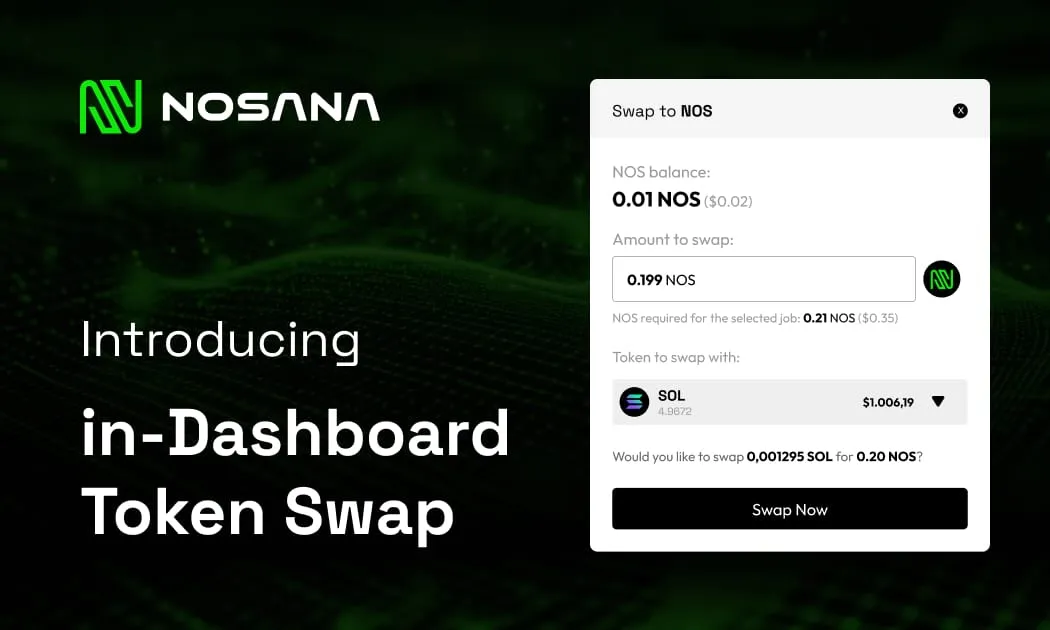
Introducing Swapping and Priority Fees

Introducing Nosana's newest features, in-Dashboard token swapping and dynamic priority fees.

Nosana's GPU Marketplace is Open to the Public
January 14, 2025 |

Nosana's GPU Marketplace is Open to the Public
Today marks a major milestone for Nosana as we officially open our GPU Marketplace to the public.
2024 at Nosana: A Year In Review
December 27, 2024 |

2024 at Nosana: A Year In Review

With the Mainnet launch just weeks away, it feels like the right time to reflect on the milestones that have defined 2024.

Road to Mainnet: Nosana's Next Chapter
December 23, 2024 |

Road to Mainnet: Nosana's Next Chapter

The Nosana Test Grid is now production-ready, paving the way for the upcoming launch of the Nosana Mainnet.

Test Grid Phase 3: final steps to mainnet
September 30, 2024 |

Test Grid Phase 3: final steps to mainnet

Today Nosana’s Test Grid has successfully transitioned to its third and final phase. This is an exciting time, as the final core components for Nosana’s Main Grid will be rolled out and tested.

LLM Benchmarking: Cost Efficient Performance
September 13, 2024 |

LLM Benchmarking: Cost Efficient Performance

Explore Nosana's latest benchmarking insights, revealing a compelling comparison between consumer-grade and enterprise GPUs in cost-efficient LLM inference performance.

Nosana Team is Heading to Singapore for Solana Breakpoint and Token2049
September 11, 2024 |

Nosana Team is Heading to Singapore for Solana Breakpoint and Token2049

The Nosana team is heading to Singapore for Solana Breakpoint and Token2049 to connect with builders and innovators in the DePIN and AI sectors.

LLM Benchmarking on the Nosana grid
August 5, 2024 |

LLM Benchmarking on the Nosana grid

In this article, we will go over the required fundamentals to understand how benchmarking works, and then show how we can use the results of the benchmarks to create fair markets.

Nosana Staking Program Update
May 21, 2024 |

Nosana Staking Program Update

To ensure the network's continued success and long-term potential, we're implementing a key update to our staking program.

Nosana at Solana Hacker House Dubai 2024
April 9, 2024 |

Nosana at Solana Hacker House Dubai 2024

Our core team is heading to Solana Hacker House Dubai edition to connect with builders and innovators in the DePIN and AI sector.

Test Grid Phase 2 Update
April 3, 2024 |

Test Grid Phase 2 Update

An update on our plans for Test Grid Phase 2

How AI Inference Drives Business Applications in 2024
March 8, 2024 |

How AI Inference Drives Business Applications in 2024

AI inference bridges the gap between complex AI models and their practical use cases.

Testing the First GPU Grid for AI Inference
February 5, 2024 |

Testing the First GPU Grid for AI Inference

Nosana has successfully tested the first decentralized GPU grid developed and customized for AI inference workloads.

Exploring the Distinctions Between GPUs and CPUs
January 30, 2024 |

Exploring the Distinctions Between GPUs and CPUs

Initially devised for graphics rendering in gaming and animation, GPUs now find applications well beyond their initial scope.

An In-depth Exploration of AI Inference: From Concept to Real-world Applications
January 24, 2024 |

An In-depth Exploration of AI Inference: From Concept to Real-world Applications

In this third chapter of the Nosana Edu series, we'll break down how AI inference works, explore its fundamental concepts, and discuss how it's impacting businesses and industries.

Nosana's Strategic APY Adjustment for Balanced Growth and Stability
January 12, 2024 |

Nosana's Strategic APY Adjustment for Balanced Growth and Stability

Aligning Long-term Success with Sustainable Rewards

Deep Learning Unveiled: Navigating Training, Inference, and the GPU Shortage Dilemma
January 11, 2024 |

Deep Learning Unveiled: Navigating Training, Inference, and the GPU Shortage Dilemma

Right now this field is facing a big problem: there aren't enough GPUs

Nosana 2023: Pioneering AI and GPU Computing
January 2, 2024 |

Nosana 2023: Pioneering AI and GPU Computing

With the demand for AI inference showing no signs of slowing, our commitment in 2023 centered on scaling up new capacity and expanding our offerings

Deep Learning Demystified
December 28, 2023 |

Deep Learning Demystified

A Comprehensive Guide to GPU-Accelerated Data Science

Navigating a Sustainable Future in Tech: The Nosana Initiative
December 15, 2023 |

Navigating a Sustainable Future in Tech: The Nosana Initiative

Addressing the GPU Shortage with a Sustainable Lens

Test Grid Phase 1: Accelerating the AI and GPU Computing Revolution
December 1, 2023 |

Test Grid Phase 1: Accelerating the AI and GPU Computing Revolution

The launch of our Test Grid represents a significant moment in AI and GPU-compute technology

Unlock the Earning Potential of Your GPU: How to Monetize Your Hardware with Nosana
November 28, 2023 |

Unlock the Earning Potential of Your GPU: How to Monetize Your Hardware with Nosana

If you have an underutilized GPU gathering dust, it's time to turn it into a source of revenue

Nosana Launches Incentivized Public Test Grid with 3 Million $NOS
November 17, 2023 |

Nosana Launches Incentivized Public Test Grid with 3 Million $NOS

A multi-phase program that will further power the AI revolution.

Nosana's $NOS Rewards Farm on Raydium!
November 15, 2023 |

Nosana's $NOS Rewards Farm on Raydium!

Are you ready to expand your $NOS stack? Let's get started!

BreakPoint 2023: Bridging the Global GPU Shortage
November 9, 2023 |

BreakPoint 2023: Bridging the Global GPU Shortage

We're building the world's largest decentralized compute grid by directly connecting GPUs and AI users

Nosana's New Direction: AI Inference
October 13, 2023 |

Nosana's New Direction: AI Inference

GPU-compute grid for AI inference