November 12, 2025
Nosana’s Spare GPU Capacity Is Now Powering Scientific Research
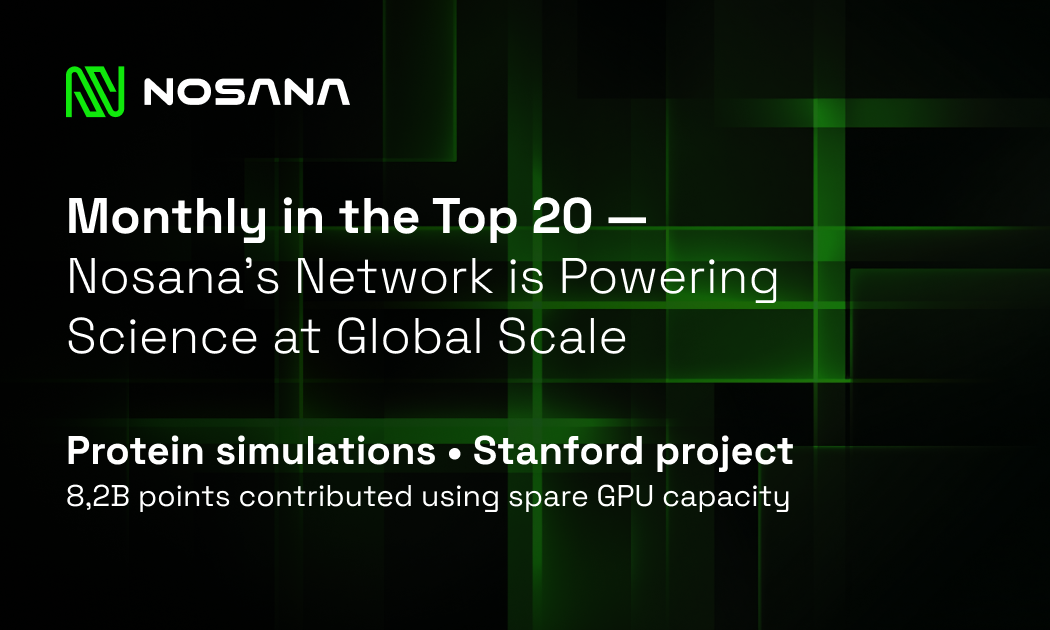
Nosana’s spare GPU power now fuels Folding@Home, advancing global biomedical research and showcasing the real-world impact of decentralized compute.
As decentralized GPU infrastructure continues to grow, so does the opportunity to enable meaningful work that extends beyond AI and machine learning. Over the past month, we’ve been allocating a percentage of Nosana’s idle compute capacity to Folding@Home — a long-standing distributed research project focused on simulating protein dynamics for biomedical science.
This initiative demonstrates the flexibility of decentralized compute and highlights how networks like Nosana can support real-world research - not just commercial workloads.
What is Folding@Home?
Folding@Home is a global scientific computing project run by Stanford researchers and collaborators. It harnesses distributed compute resources from volunteers around the world to simulate protein folding and molecular interactions. These simulations contribute to studies related to cancer, neurodegenerative diseases, viral infection mechanisms, drug discovery, and other areas of medical science.
Instead of relying solely on centralized supercomputers, Folding@Home scales compute by tapping into distributed GPU and CPU contributions. Each contributor processes small simulation tasks locally, and the results are aggregated for research teams to analyze.
How Nosana Is Contributing
Over the last month, Nosana has allocated a part of its unused GPU capacity to support these protein simulation workloads. Whenever certain GPUs on the network are not actively used for AI or builder tasks, they are from time to time redirected to Folding@Home jobs.
This approach ensures that compute on the network provides value even during idle periods, while also supporting open scientific research that can benefit global biomedical progress.
Milestone Progress
Despite being a recent contributor, Nosana is now:
-
Ranking in the Top ~20 monthly contributors worldwide
-
We are now ranked #367 all-time on Folding at Home, moving steadily upward in the global contributor leaderboard.
-
Having contributed over 8.2B Folding@Home points, reflecting both high compute throughput and work quality
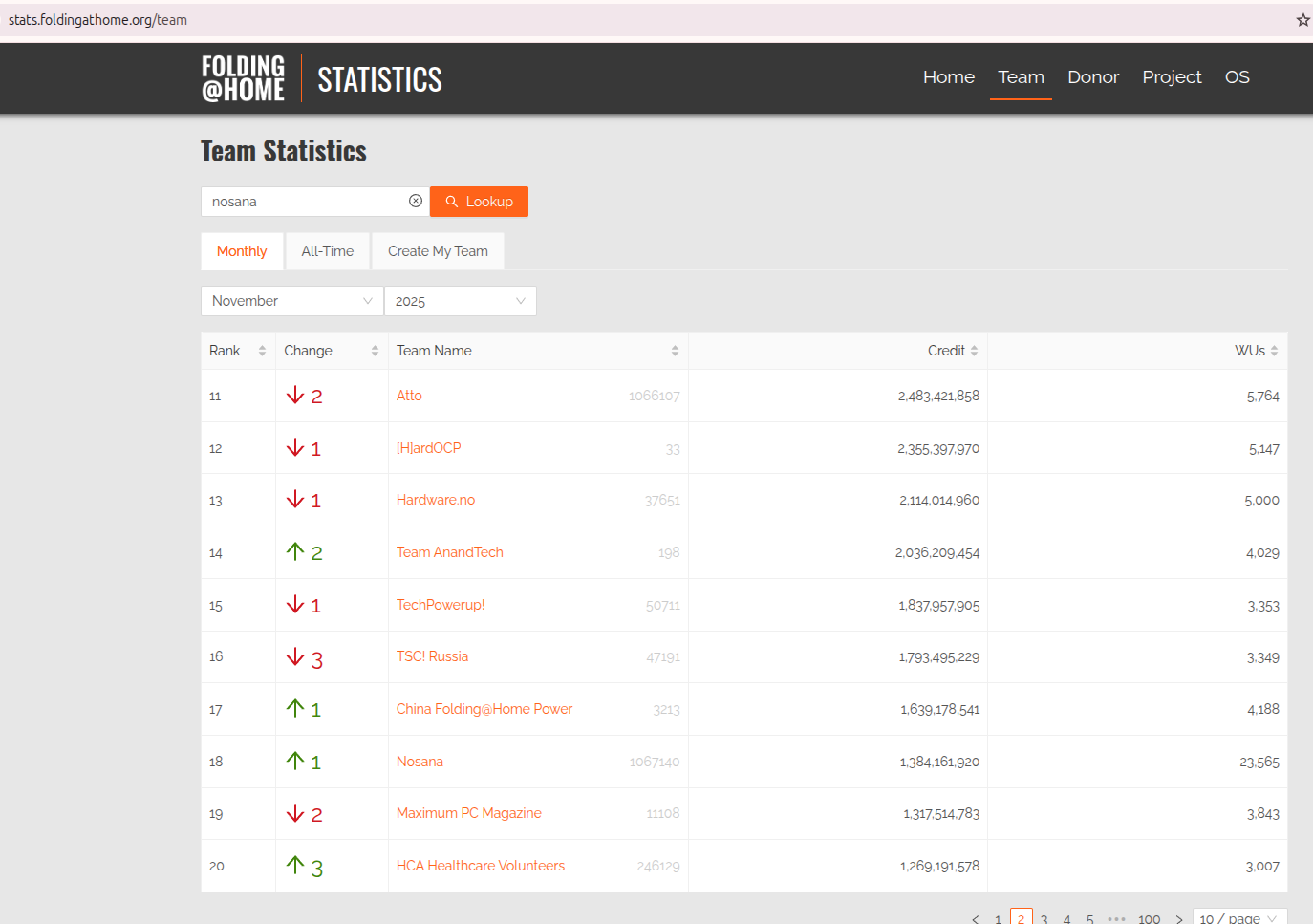
The significance lies not just in the ranking, but in how quickly this progress was achieved. Many top contributors have been active for years. Nosana’s acceleration into the upper tiers of the global leaderboard illustrates the scale and efficiency of decentralized GPU networks.
Why This Matters
Traditional scientific computation infrastructure is costly, limited, and often constrained by institutional budgets and hardware availability. Decentralized networks offer an alternative model:
-
Scalable Supply
Compute becomes accessible from thousands of distributed nodes rather than a small number of centralized clusters. -
Continuous Utilization
Idle compute can be redirected to meaningful public research instead of sitting unused. -
Aligned Incentives
Contributors, builders, and researchers benefit simultaneously.
Nosana’s contribution to Folding@Home is not a commercial initiative - it is a demonstration of what open, distributed compute can make possible when infrastructure is treated as a collaborative global resource.
Demonstrating Real-World Flexibility
By directing spare capacity to research workloads, we are reinforcing a core principle of decentralized GPU networks:
Compute should not sit idle.
The same GPUs that train machine learning models, power agentic AI workflows, or run compute-intensive builder tasks can also help accelerate scientific discovery. This is a future where compute networks are elastic, multi-purpose, and globally impactful.
What Comes Next
This is the beginning of a longer-term initiative. We plan to:
-
Continue contributing unused GPU capacity to scientific research where possible
-
Track progress as the Nosana team climbs further in the Folding@Home global rankings
-
Explore similar collaborations with other open science and public-good compute initiatives
As the Nosana network grows, so does its ability to contribute to meaningful work beyond traditional AI applications.
Decentralized compute is not just about cost efficiency or performance. It is about enabling new forms of collaboration and shared impact. By contributing to Folding@Home, we are demonstrating that a compute network can be commercially useful and scientifically valuable at the same time.
This milestone reflects what is possible when infrastructure is open, flexible, and shaped by a community rather than a centralized entity. And it is only one example of how decentralized AI compute can support real-world progress.

